-
A02. Minimal Information Content
Read more: A02. Minimal Information ContentThere is not a whole lot to say about this chromatic scale. – There are 12 steps (of theoretically, but not practically, equal distance) – After 12 steps the scale repeats, with every step doubling in frequency (this is called an octave) Alternatively, this could also just be expressed as a string of consecutive numbers: 1 2 3 4 5 6 7 8 9 10 11 12 (octave 1) 13 14 15 16 17 18 19 20 21 22 23 24 (octave 2)…
-
A01. The Chromatic Substrate
Read more: A01. The Chromatic SubstrateWe are using the 12 note chromatic scale as the basic substrate for our exploration of music theory and its possible parallels with the fabric of reality. Above the twelve steps with sound frequencies above each step (or “station”). The Chromatic Scale normally used in modern Western music has a pretty clear definition. “Our” chromatic scale has 12 pitches of increasing frequency. For now we call these pitches 1, 2, 3,…..12. After step 12 the scale repeats, but every pitch/note will have a…
-
A. Only A Music Theory
Read more: A. Only A Music TheoryWhen I started playing guitar at age 14 or so, I was concentrating on the sheer awkwardness of getting to make my fingers hold down the right string in the right position. Only after the physical aspect got a little easier and more second nature, did music theory come in the mix. At first it was learning about various chords that somehow belong together. At some point the need to improvise a melody arose. You use a scale, or two, or three. Then…
-
Who controls the 8th string?
Read more: Who controls the 8th string?A few years ago I started playing seven string guitar. It’s only an added B string below the low E. And while I am practicing quite a bit, composed several pieces for seven string classical guitar and adapted J. S. Bach’s 15 Two Part Inventions and all of the Well Tempered Clavier for the instrument, only now do I start feeling somewhat comfortable. Sure, there is the issue of smaller string spacing on my seven string electrics. Then there is my habit of…
-
The morning-after-blues
 Read more: The morning-after-blues
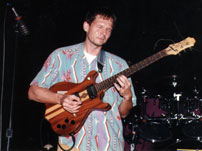
This past week I was brutally reminded why being a musician is so hard. It’s not because of the need to practice (although you have to do that.) It’s not because you basically starve if you have no other job, or your spouse loves you very much and has a good gig with health insurance. It’s not really because it often sucks hunting down gigs and then often end up playing at venues that are “wrong” for what you play – although we are…
-
Restoring my first electric guitar
Read more: Restoring my first electric guitarLast week I finally finished the restoration of my first electric guitar. A Framus S370 – basically a German Gibson SG copy. I didn’t quite find out when this was built – probably very early 1970s. I bought it used from Musik Ecke in Albstadt, West Germany. When I opened the rear cover I found the original invoice which dates my purchase to November 1974. This guitar was in great shape when I got it. Then, a few years later, I decided to…
- Call the Police video (2)
- Comics (5)
- Construction (2)
- Deep Reality Anomalies (10)
- Documentary (5)
- Food (1)
- Fringelab (1)
- Griffy Lake (2)
- Hands-On (1)
- Home Improvement (1)
- Meta-Deep-Reality (1)
- Music (6)
- Music & Science (10)
- Peter's Money (2)
- Philosophy (4)
- Rantings (4)
- Rounding Errors (4)
- Science (10)
- SF (2)
- Solar Energy (8)
- Space (5)
- Turn-o-trope (1)
- UFO (3)
- Video & Animation (7)
- Workshop (1)